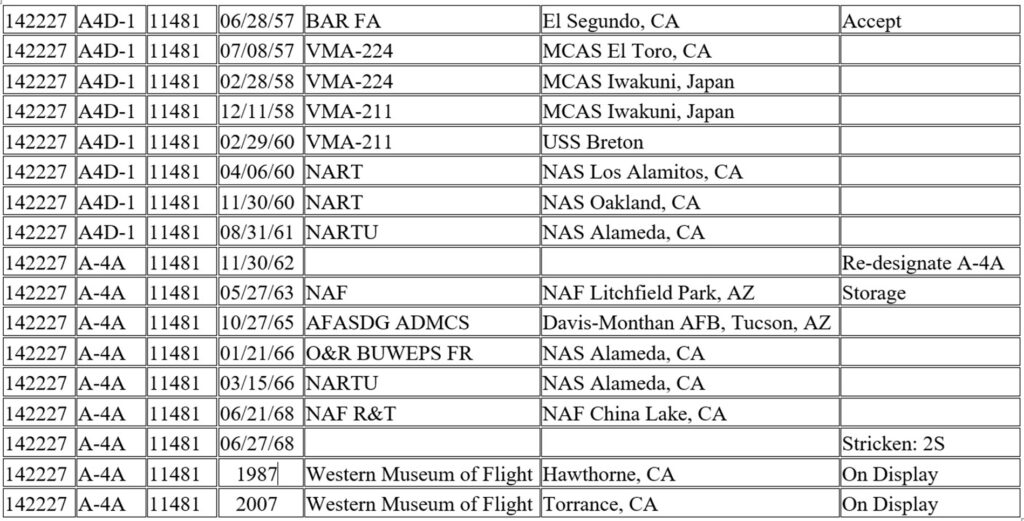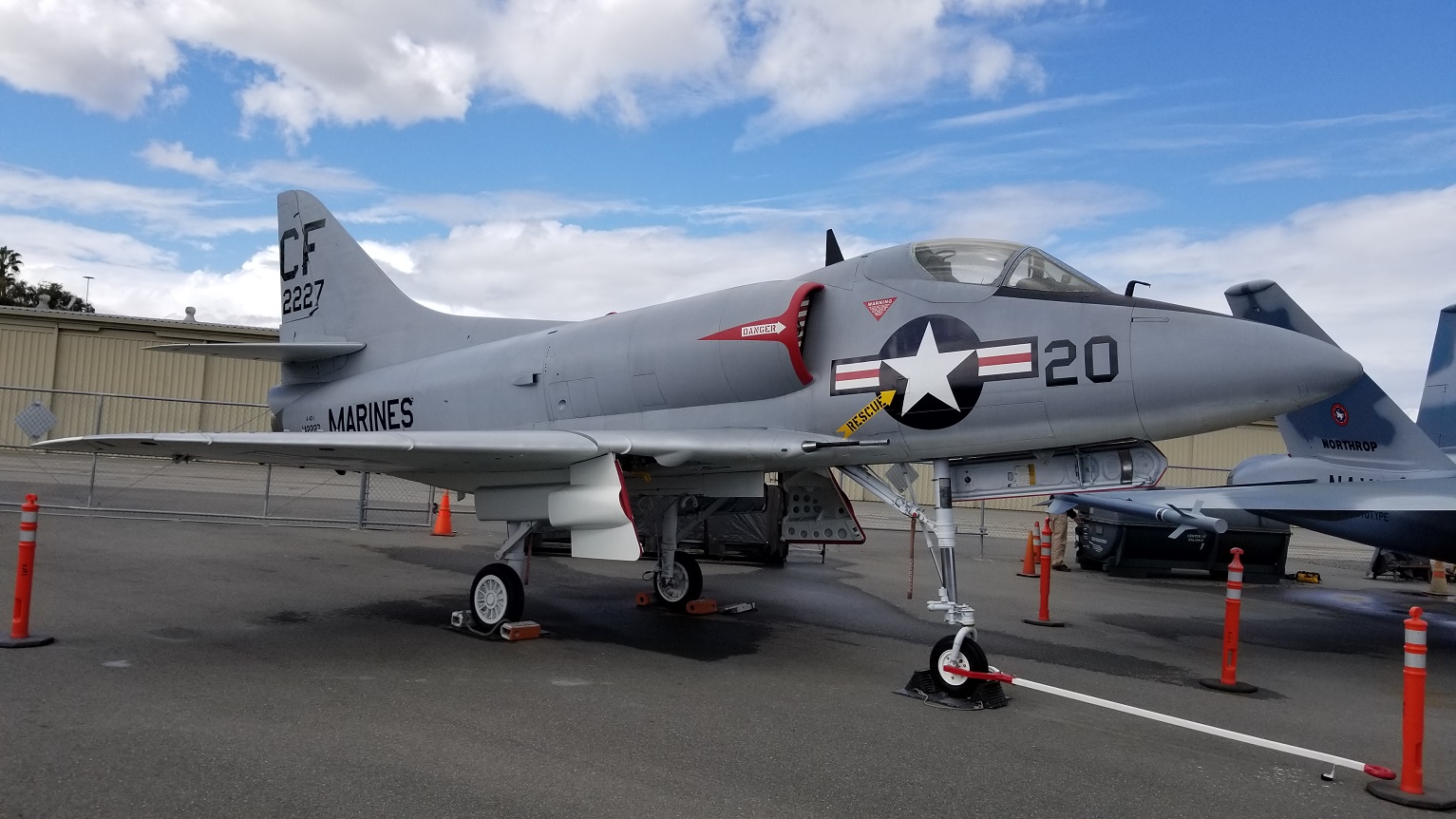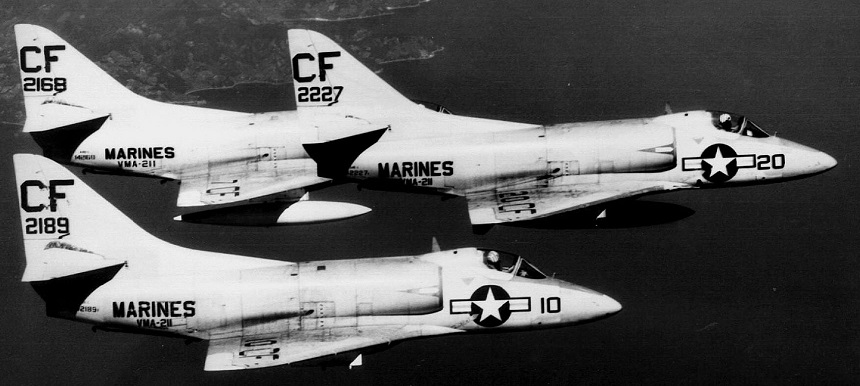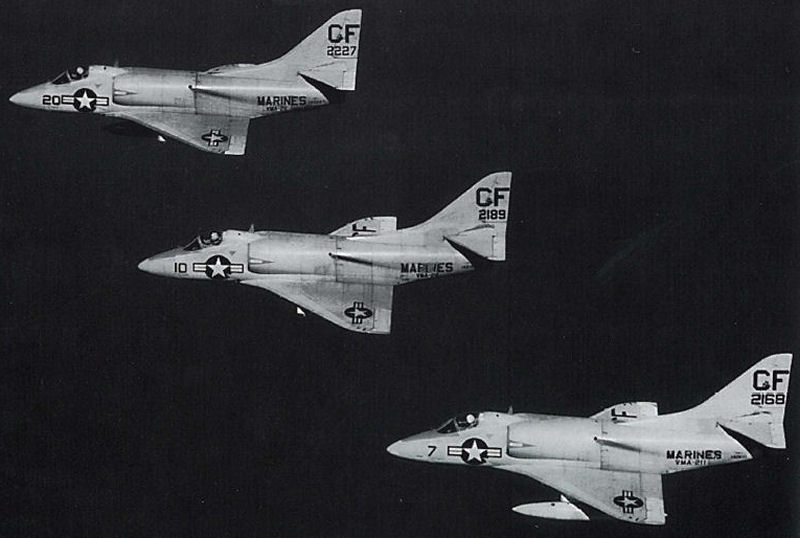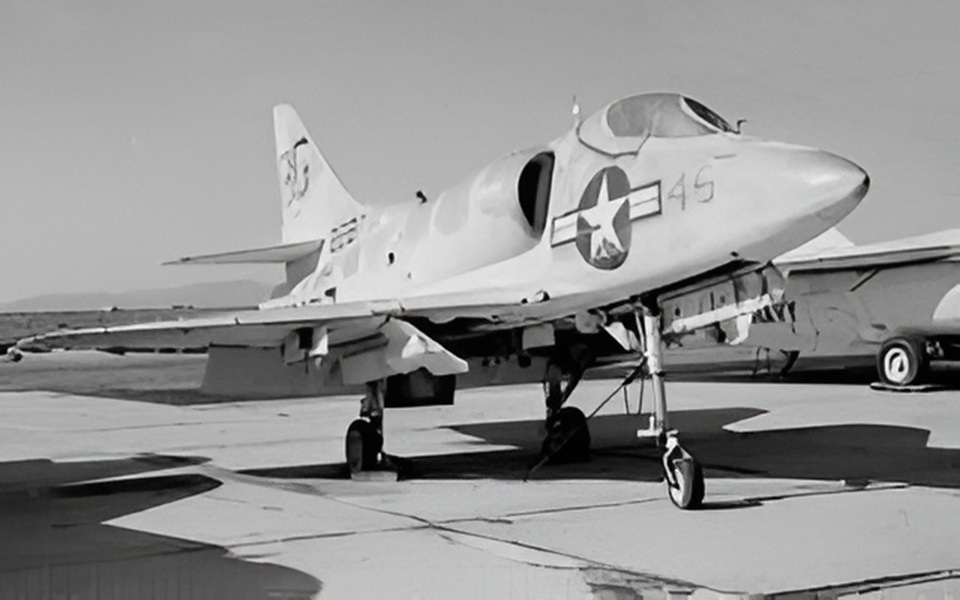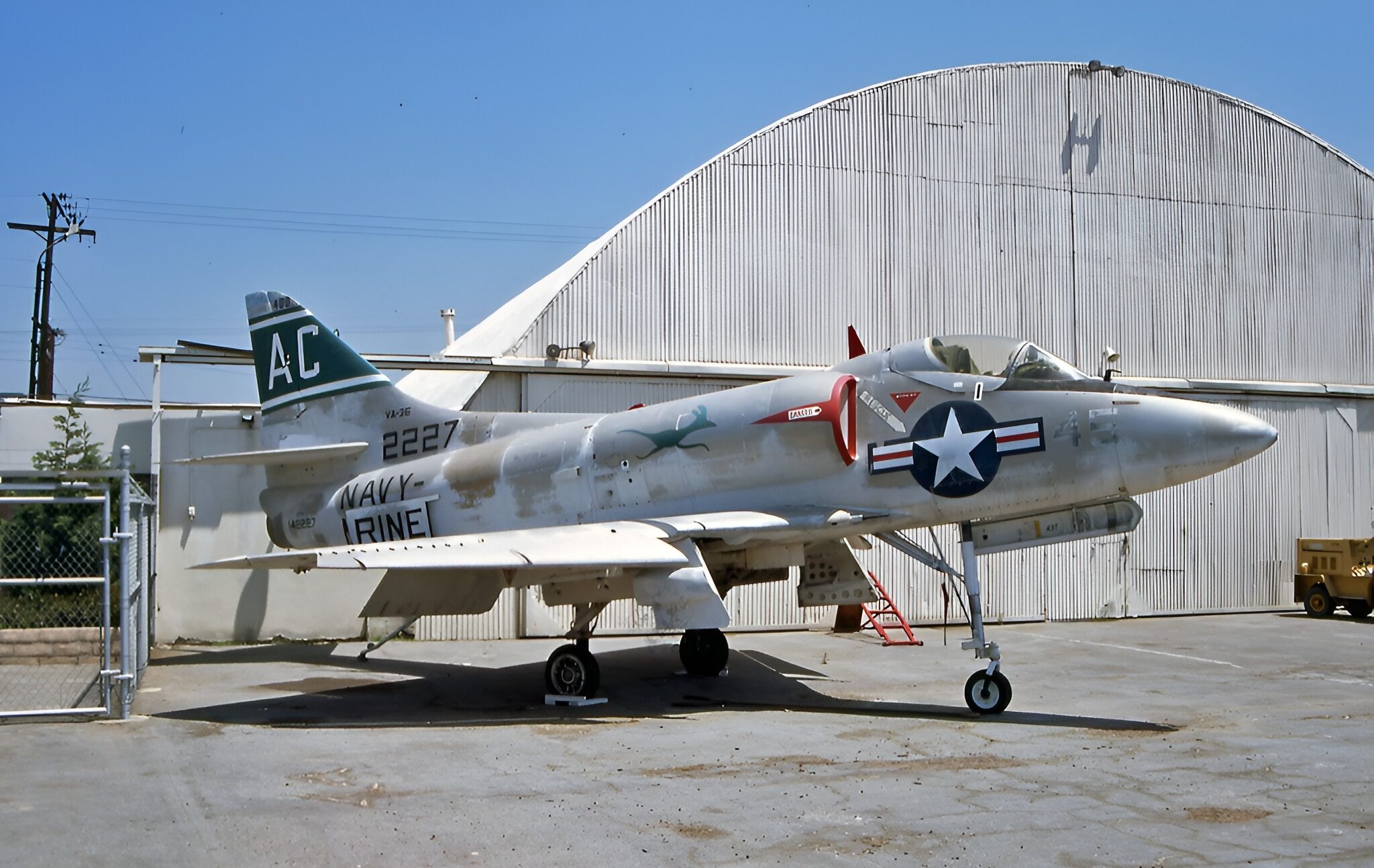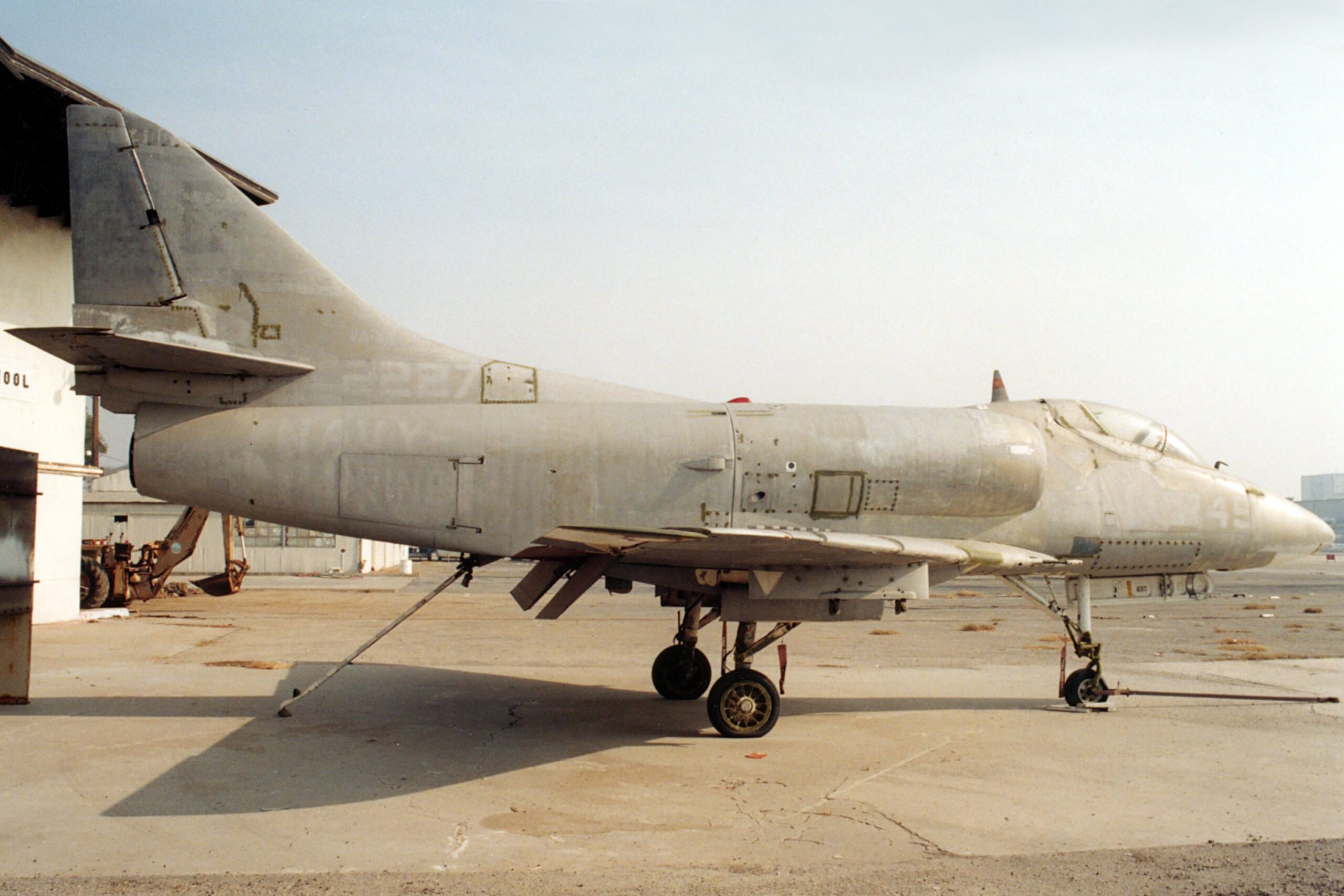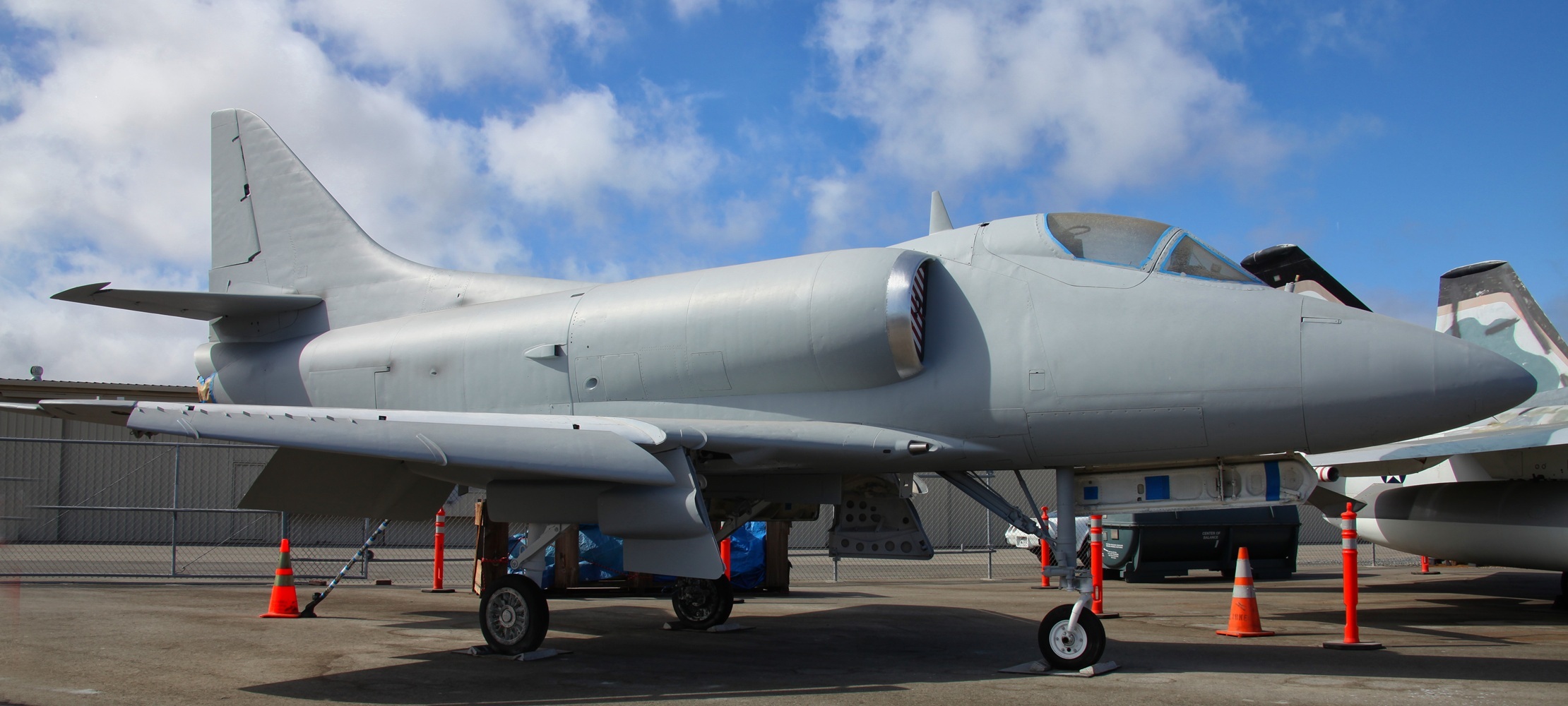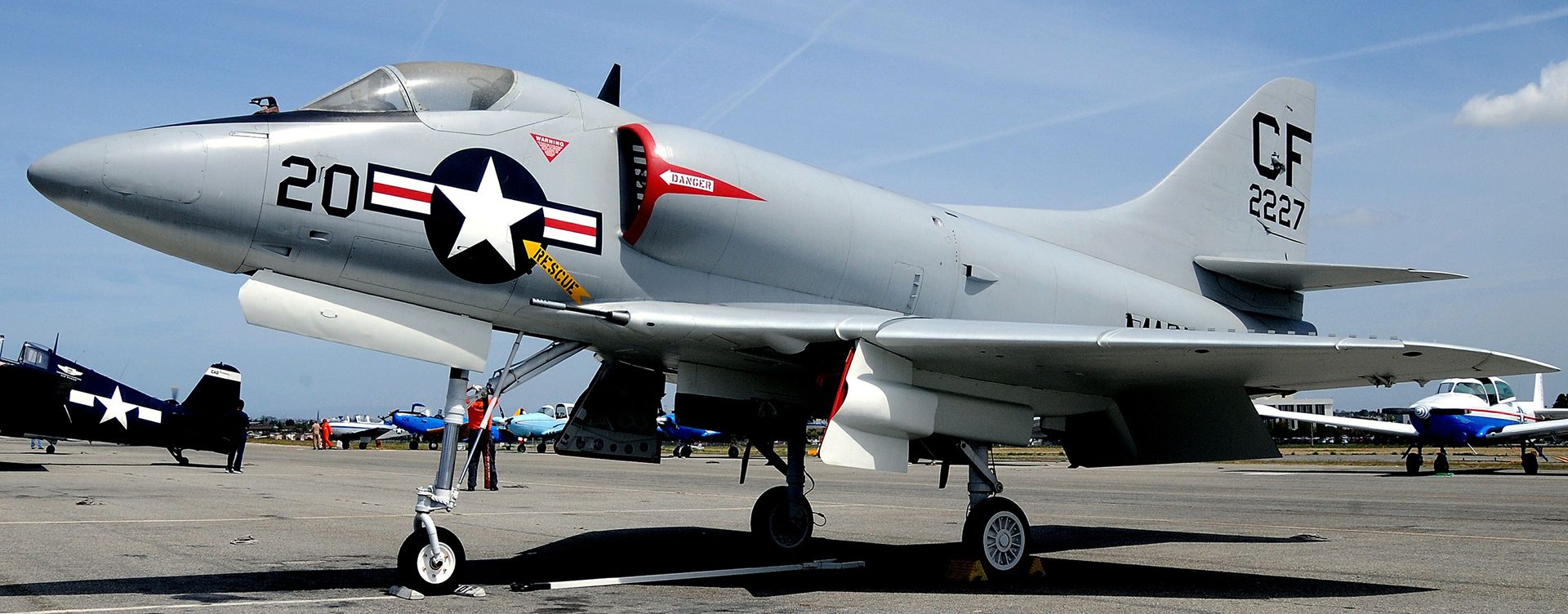
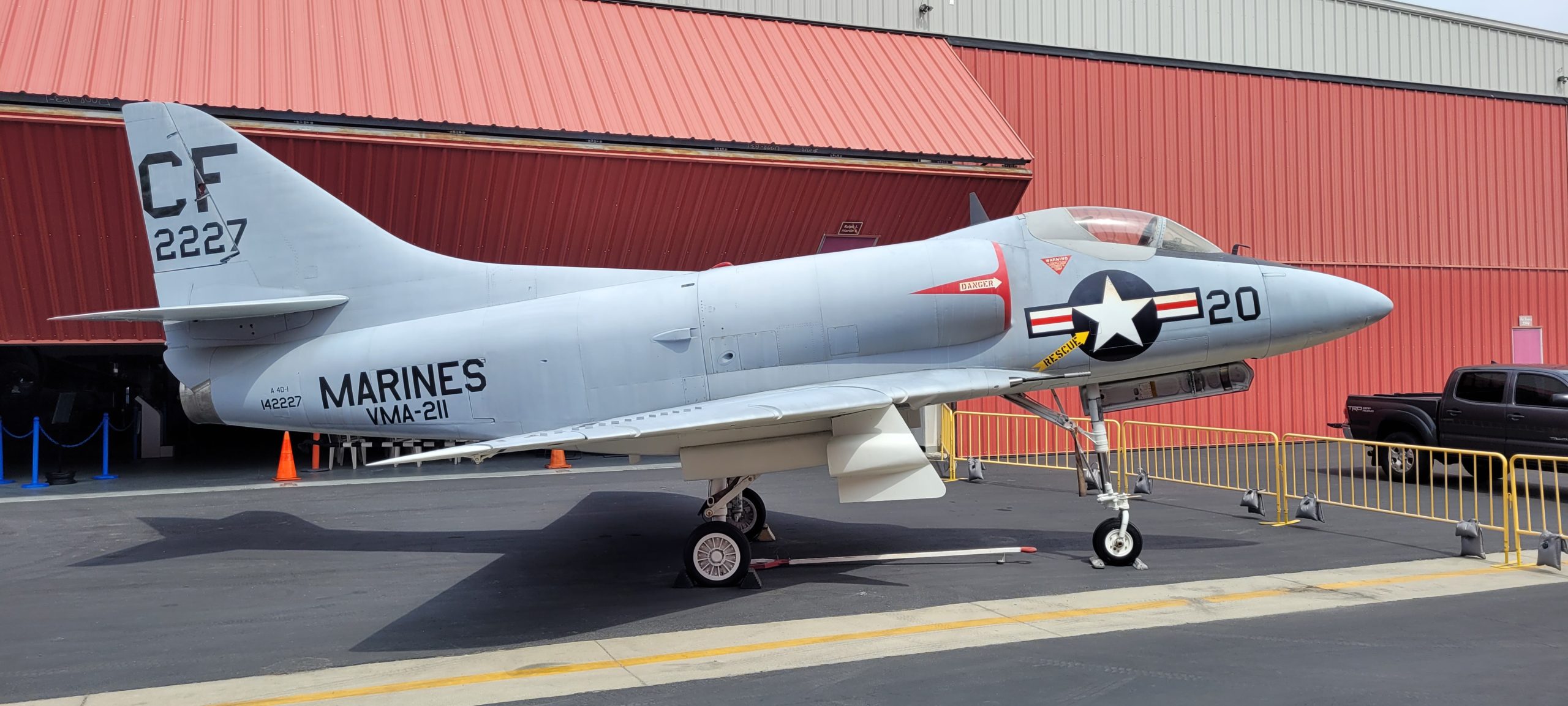
The Western Museum of Flight’s Douglas A-4A Skyhawk was assigned the USMC BuNo. 142227, C/N 11481 on 08 July 1957, with VMA-224, MCAS El Toro, CA. VMA-224 was the first Marine squadron to receive the Douglas A-4A Skyhawk. Deployed 11 Dec 1958, assigned to VMA-211, MCAS Iwakuni, Japan. A former Marine aviator wrote to inform us that he flew this particular aircraft, BuNo. 142227, while stationed in Japan.
The Douglas A-4 Skyhawk is a carrier-capable ground-attack aircraft designed for the United States Navy and U.S. Marine Corps. The delta-winged, single turbojet-engined Skyhawk was designed and produced by Douglas Aircraft Company, and later McDonnell Douglas.
The Navy issued a contract for the type on 12 June 1952 and the XA4D-1 prototype made its first flight on 22 June 1954 from Edwards Air Force Base, California. Produced from 1954 to 1979, deliveries to Navy and U.S. Marine Corps squadrons (to VA-72 and VMA-224 respectively) commenced in late 1956.
The A4D-1 was redesignated as A-4A in 1962 when the Dept of Defense implemented the Tri-Service Designation System to standardize military aircraft designations for all branches of services.
The Skyhawk was designed by Douglas Aircraft’s chief engineer, Ed Heinemann, in response to a U.S. Navy request for a jet-powered attack aircraft to replace the older AD Skyraider. Heinemann opted for a design that would minimize its size, weight, and complexity. The result was an aircraft that weighed only half of the Navy’s weight specification. It had a compact wing that did not need to be folded for carrier stowage. The diminutive Skyhawk soon received the nicknames “Scooter”, “Kiddiecar”, “Bantam Bomber”, “Tinker Toy Bomber”, and, on account of its nimble performance, “Heinemann’s Hot-Rod”.
The aircraft is of conventional post-World War II design, with a low-mounted delta wing, tricycle undercarriage, and a single turbojet engine in the rear fuselage, with two air intakes on the fuselage sides. The tail is of cruciform design, with the horizontal stabilizer mounted above the fuselage. Armament consisted of two 20 mm (.79 in caliber) Colt Mk 12 cannons, one in each wing root, with 200 rpg, plus a large variety of bombs, rockets, and missiles carried on a hardpoint under the fuselage centerline and hardpoints under each wing (originally one per wing, later two).
The choice of a delta wing, for example, combined speed and maneuverability with a large fuel capacity and small overall size, thus not requiring folding wings, albeit at the expense of cruising efficiency. The leading-edge slats were designed to drop automatically at the appropriate speed by gravity and air pressure, saving weight and space by omitting actuation motors and switches. Similarly, the main undercarriage did not penetrate the main wing spar. Designed so that when retracted, only the wheel itself was inside the wing and the undercarriage struts were housed in a fairing below the wing. The wing structure itself was lighter with the same overall strength, and the absence of a wing-folding mechanism further reduced weight. This is the opposite of what can often happen in aircraft design where a small weight increase in one area leads to a compounding increase in weight in other areas to compensate, leading to the need for more powerful, heavier engines and so on in a vicious circle.
The A-4 pioneered the concept of “buddy” air-to-air refueling. This allows the aircraft to supply others of the same type, eliminating the need for a dedicated tanker aircraft, a particular advantage for small air arms or when operating in remote locations. This allows for greatly improved operational flexibility and reassurance against the loss or malfunction of tanker aircraft, though this procedure reduces the effective combat force on board the carrier. A designated supply A-4 would carry a center-line mounted “buddy store”, a large external fuel tank with a hose reel in the aft section and an extensible drogue refueling bucket. This aircraft was fueled up without armament and launched first. Attack aircraft would be armed to the maximum and given as much fuel as was allowable by maximum takeoff weight limits, far less than a full tank. Once airborne, they would then proceed to top off their fuel tanks from the tanker using the A-4’s fixed refueling probe on the starboard side of the aircraft nose. They could then sortie with both full armament and fuel loads. This practice was superseded with the introduction of the KA-3B Skywarrior tanker in 1967 during the Vietnam War.
The A-4 was also designed to be able to make an emergency landing, in the event of a hydraulic system failure, on the two underwing drop tanks nearly always carried by these aircraft. Such landings resulted in only minor damage to the nose of the aircraft which could be repaired in less than an hour. Ed Heinemann is credited with having a large “K.I.S.S.” sign put up on the wall of the engineering office when the aircraft was being designed. Whether or not this is true, the A-4 certainly is a shining example of the application of that principle to aircraft design.
Fifty years after the aircraft’s first flight, and having played key roles in the Vietnam War, the Yom Kippur War, and the Falklands War, some of the nearly 3,000 Skyhawks produced remain in service with several air arms around the world, including active duty on the aircraft carrier, Sao Paulo, of the Brazilian Navy.
The Skyhawk remained in production until 1979, with a total of 2,960 aircraft built, including 555 two-seat trainers. The last production A-4, an A-4M issued to a Marine squadron (VMA-223) had the flags of all nations that operated the A-4 series aircraft painted on the dorsal avionics ‘hump’.
The Skyhawk proved to be a relatively favored U.S. naval aircraft export of the postwar era. Due to its small size, it could be operated from the older, smaller World War II-era aircraft carriers still used by many smaller navies during the 1960s. These older ships were often unable to accommodate newer USN fighters such as the F-4 Phantom II and F-8 Crusader, which were faster and more capable than the A-4, but significantly larger and heavier than earlier naval fighters.
The US Navy operated the A-4 in both Regular Navy and Naval Reserve light attack squadrons (VA). Although the A-4’s use as a training and adversary aircraft would continue well into the 1980s, the Navy began removing the aircraft from its front-line attack squadrons in 1967, with the last one being retired in 1975.
The U.S. Marine Corps did not select the U.S. Navy’s replacement warplane, the A-7 Corsair II, instead keeping Skyhawks in service with both Regular Marine Corps and Marine Corps Reserve attack squadrons (VMA), and ordering the new A-4M model. The last USMC Skyhawk was delivered in 1979, and they were used until the mid-1980s before they were replaced by the equally small, but more versatile STOVL AV-8A Harrier.
The A-4’s nimble performance also made it suitable to replace the F-4 Phantom II when the Navy downsized its aircraft for the Blue Angels demonstration team, until replaced by the F/A-18 Hornet in the 1980s. The last US Navy Skyhawks, TA-4J models belonging to the composite squadron VC-8, remained in military use for target-towing and as adversary aircraft, for combat training at Naval Station Roosevelt Roads. These aircraft were officially retired on 3 May 2003.
Skyhawks were well-loved by their crews for being tough and agile. These attributes, along with their low purchase and operating cost as well as easy maintenance, have contributed to the popularity of the A-4 with American and international armed forces. Besides the United States, at least three other nations have used A-4 Skyhawks in combat (Israel, Argentina, and Kuwait). Retired from service: 2003, U.S. Navy; 1998, USMC; 2015, Israeli Air Force.
The A-4A BuNo. 142227 is currently on display at the Western Museum of Flight at Torrance Airport. Please contact the Western Museum of Flight at [email protected] if you are interested in support of the restoration and preservation of this historic A-4A aircraft.
Based on records, A4D-1 / A-4A 142227, C/N 11481 has the following unit history